eCommerce is Dead
Category: ecommerce
Bernardo Torres, Founder, Uncommon Business - 2026-04-14
Harvard Business Review published an analysis this week that should make anyone selling digitally pay attention. The thesis is simple: AI agents (the ones that buy, compare, and decide for you) are breaking the business model of Google, Meta, and Amazon all at once.
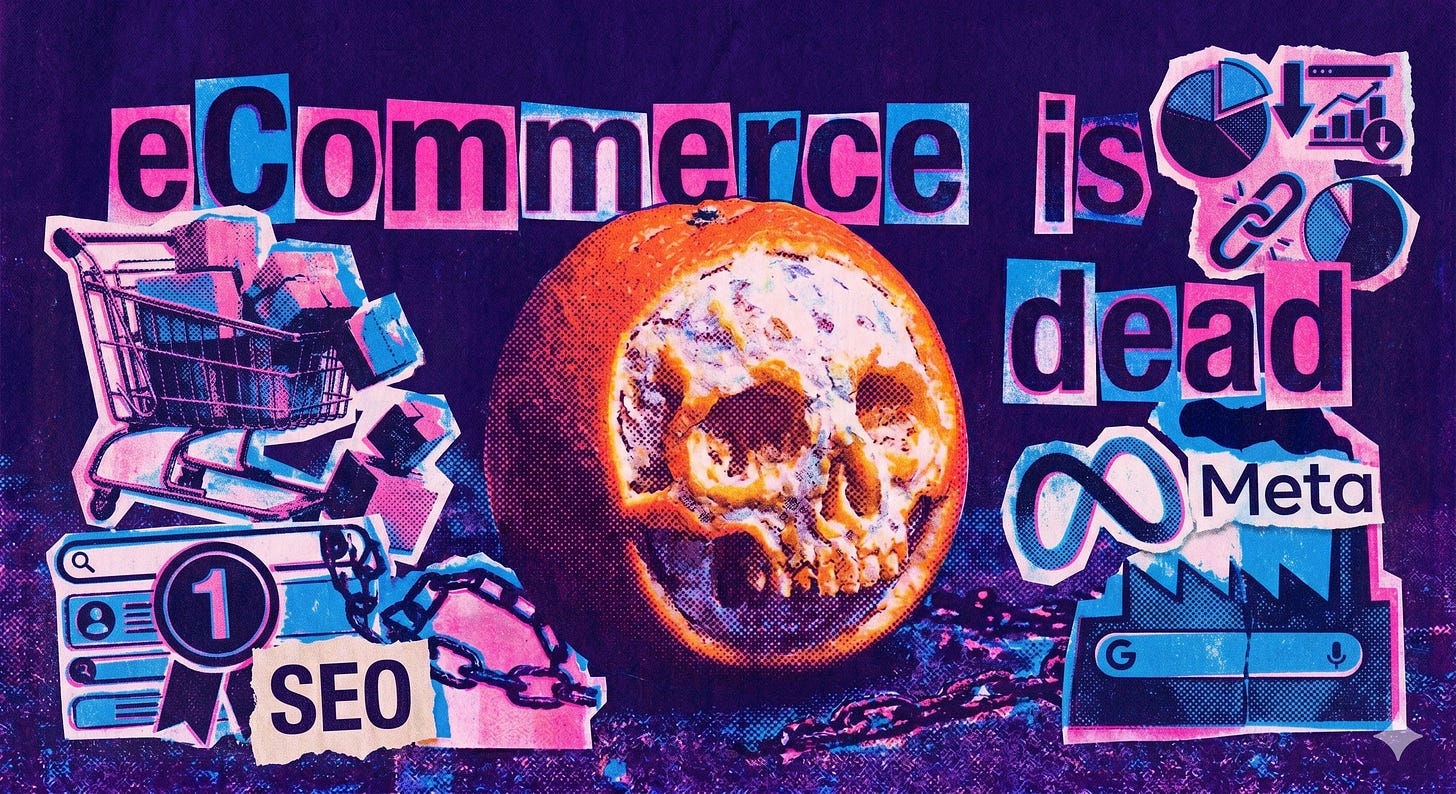
Why? Because an AI agent doesn't see ads. Doesn't impulse buy. Doesn't stick to your ecosystem because "they already paid for Prime." Has no brand loyalty. It compares everything, everywhere, and executes.
The authors call it "zero-click commerce": the purchase that goes from intent to execution without passing through any screen where you can stick an ad.
This isn't theory. During Cyber Week 2025, AI agents influenced $67 billion in global sales. AI traffic to retail grew 805% on Black Friday. Nearly half of Gen Z and Millennials left their holiday shopping to an agent.
This is already happening.
Now bring that to Latin America.
Many companies barely figured out ecommerce during the pandemic. In a rush. With patches. They uploaded their catalog to a platform, slapped on the same pricing as the physical store, and called it digital transformation.
That model already has an expiration date.
Not because they did it wrong, but because the entire logic is changing. What you built for a human to find you doesn't work for a machine to choose you. An AI agent doesn't browse your site, doesn't see your banner, doesn't read your copy. It reads structured data, compares prices, and decides in milliseconds.
The question is no longer "do you have ecommerce?"
It's: is your business legible to a machine?
And no, this isn't solved with a platform upgrade.
When the buyer is a machine, the advantage is no longer in the pretty interface or the well-targeted ad. It's in three things:
Cultural intelligence that becomes data. Agents will optimize for price and speed—anyone can do that. But consumption in Latin America has layers that no generic agent captures. Who explains to an AI that in December here people buy to show off, not to optimize? That trust is built differently in a market with 60% informality?
That cultural intelligence is competitive advantage, but only if you convert it into structure, not intuition.
That's what CAIOS exists for: converting cultural signals into strategic inputs that an executive team can use and that, eventually, an AI agent can read.
Innovation capacity that doesn't depend on hype. The most expensive mistake right now is treating AI as a technology project. It's not. It's a market structure shift. And that's not solved with pilots, it's solved with internal muscle to innovate continuously.
That's what the Innovation Factory exists for: methodology, processes, and governance so innovation is operation, not event.
Focus before speed. The temptation is to run. Implement AI in everything. Automate whatever you can. But real strategy is revealed in how you allocate resources, not in what you declare. If you're putting budget into "AI projects" without having defined where you compete, you're doing decorative innovation.
And decorative innovation is expensive, not because it costs a lot, but because it distracts.
Three questions you should be asking yourself today, not in 2027:
Is your product legible to an AI agent? Structured data, dynamic pricing, clean metadata. If your catalog is a glorified PDF, you've already lost.
Does your strategy depend on human attention? If your acquisition is based on ads, SEO, and retargeting, you're investing in infrastructure that an agent simply ignores. It doesn't die tomorrow, but each quarter it works a little less.
Can you adapt on your own or do you need someone to tell you what to do every time? The company that needs a consultant for every change doesn't have strategy, it has dependency.
CAIOS and the Innovation Factory are two modules of the Uncommon OS, a single strategic operating system. One gives you the map. The other gives you the engine.
Together they solve what no AI tool solves alone: knowing what to do and having the organizational capacity to do it.
Because the future doesn't belong to whoever has the best AI. It belongs to whoever knows what to ask it.
Uncommon Question:
If the buyer of the future doesn't see you, doesn't search for you, and doesn't give you a second chance… what are you doing today to be chosen by a machine that has no patience or loyalty?
Related articles
- Being a Dangerous Man — If I ever have boys, they'll be dangerous men." from the poem by Daragh Fleming
- The Inertia Innovation Index that IDEO validated for us — The Inertia Innovation Index measures the ratio between the value of an opportunity when it's born and what your organization actually produces with it.
- The Day I Stopped Trusting My Own Thinking — Recent research reveals that the more we use AI, the less confidence we have in our ideas. The problem isn't that it makes us dumb, it's something worse.