The trap of creating without friction
Category: creatividad
Bernardo Torres, Founder, Uncommon Business - 2026-04-23
This week I had lunch with a friend who's a mathematician and algorithm specialist, and he dropped something that had been spinning in my head for weeks without knowing how to name it. He said: "I can't stop coding." He said it like someone confessing an addiction. With a bit of guilt, a bit of pride.
The exact same thing is happening to me.
My friend dedicates his professional life to making AI models faster. He optimizes the algorithms that reduce latency between the prompt and the response. Meaning, he's working with mathematical precision to accelerate exactly the mechanism that's making both of us compulsive.
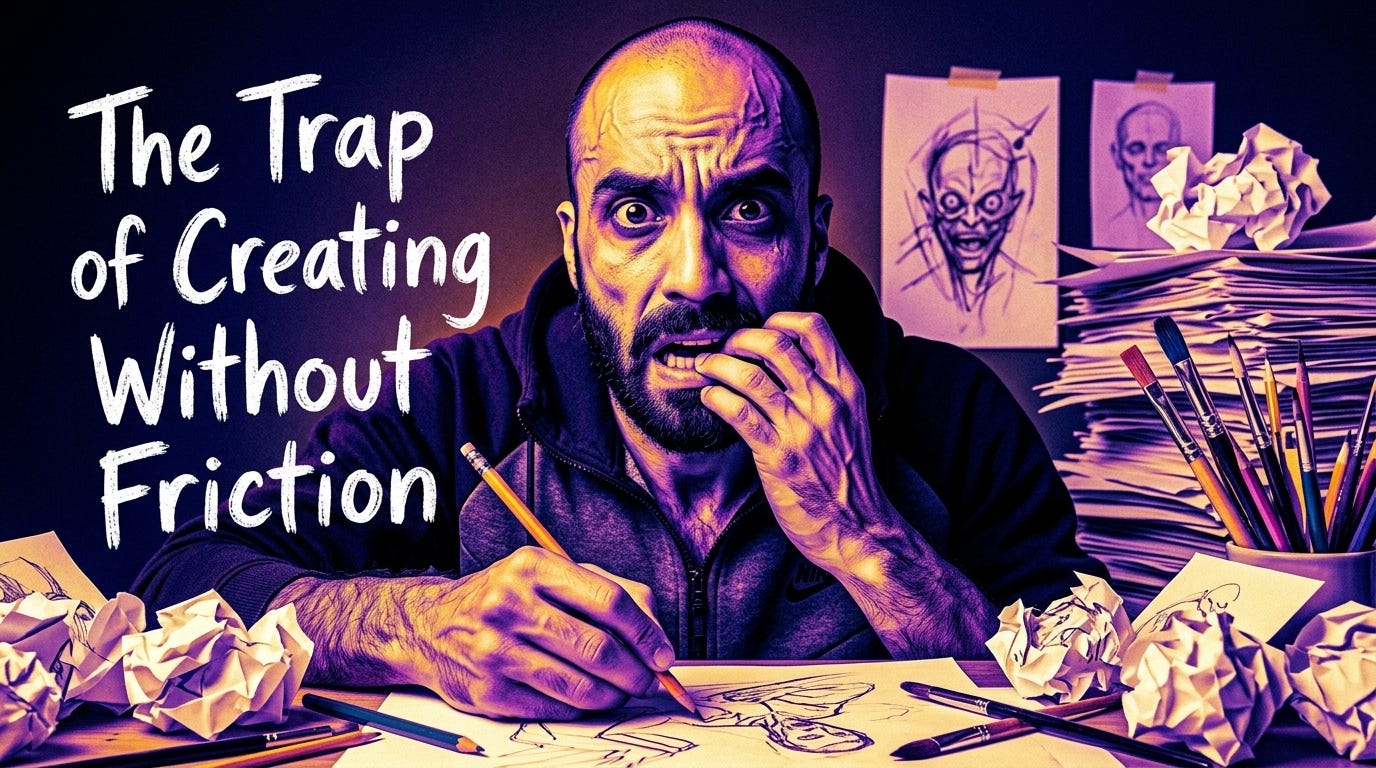
I've spent months starting projects at a pace that would have been impossible before. An MVP of an app for couples. A supplements brand with complete brandbook and go-to-market model. A SaaS for remote teams with cognitive profiling modules. A conceptual operating system for Uncommon. An internal briefing tool. A complete narrative for a parent-child gaming platform with pedagogical framework.
Each one was, in its moment, an obsession. Each one had me hours in front of the screen in a flow state. Each one left me, at the end of that first wave, with a strange sensation. A mix of satisfaction and emptiness. Like having eaten something delicious that doesn't nourish.
And then I abandoned each one to start the next.
The broken loop
Creating always produced pleasure, but that pleasure had two distinct sources. The first came from exploring how to do it. The second, from seeing it work. They were two separate dopamine hits, and the first was the most valuable because it demanded time, effort, and intelligence.
AI eliminated the first one.
Today the interval between "I have an idea" and "I have a functional prototype" shrunk to minutes. The effort of figuring it out got outsourced. What remains is only the second hit, the one of seeing the thing exist. Faster, more accessible, more frequent. But also more superficial.
And there's something worse. That waiting interval while the AI generates, those seconds of suspense are the mechanism that makes it addictive. In behavioral psychology it's called reinforcement schedule, and it's the most addictive neurochemical structure that exists. AI didn't design it on purpose, but it replicates it perfectly. And my friend, the mathematician, is working on making those intervals even faster.
Mark Craddock named it in May 2025: vibe code addiction. Developers who can't stop prompting, who feel the compulsive urge to return, who describe entire sessions where the notion of time disappears and the result, though abundant, rarely crosses the border toward something finished.
It's not just with code, it's with everything. With strategy, with branding, with writing, with business design. Any activity where AI collapses the time between idea and artifact.
Friction as a filter
Here's the part that was hard for me to accept. For years I believed that friction in the creative process was a cost to eliminate. That the faster I could go from idea to prototype, the better. That efficiency was virtue but it's not.
Friction isn't a bug in the creative process. It's the natural filter that distinguishes ideas that deserve to exist from those that only deserve to be thought. When building a brand takes weeks, you only build the one that's worth it. When putting together an investment deck takes days, you only do it for ideas you're going to defend. When developing an MVP takes months, you only do it for hypotheses you've already validated in real conversations.
Friction forces you to choose before building. It forces you to have criteria.
Without friction, you build first and choose later. But choosing later is much harder, because there's already attachment to the created object. There's already author's pride. So you don't choose, you accumulate. And when you look back you discover you have ten live projects and none finished, and you tell yourself it's because you're very creative, when the truth is you lost the filter.
What I couldn't do before
Before I couldn't build a functional MVP of an app for couples in an afternoon. Now I can. Before I couldn't develop the complete visual identity of a supplements brand before noon. Now I can. Before I couldn't generate the conceptual operating system of a consultancy in a weekend. Now I can. Before I couldn't write an article with theoretical framework, cross-references and articulated thesis in two hours. Now I can, in fact I'm doing it right now.
This is the part I can't and don't want to deny. AI amplified me. It gave me capabilities I would have paid to have two years ago. It opened creative spaces that were previously sealed by the cost of production.
But the amplification of capabilities without amplification of criteria isn't amplification. It's accelerated dispersion.
What changed isn't what I can do, it's what I have to decide not to do. And that muscle (the one of deciding what not to do when everything is possible) is exactly the one AI doesn't amplify. That muscle I have to build myself, with human discipline, old-fashioned, boring.
Criteria, not control
I'm not going to close this article with a list of productivity tricks. That would betray the point. The problem isn't technical, it's structural. And the solution isn't in imposing an ideal pseudo-monk creative system (from a coach's book) that I'll never sustain. It's in something more honest and more difficult: knowing myself.
I know what my strengths are, I have a genuine capacity to see connections between disciplines, to translate complex concepts into usable frameworks, to generate narrative around ideas. AI amplifies those strengths extraordinarily, and it would be stupid to slow them down out of fear of compulsivity.
I also know what my weaknesses are. I seek validation through visible output. I struggle more with sustaining than starting. I get excited about the new more than I fall in love with the existing. And AI, without discipline, is gasoline for all those weaknesses.
So the work isn't to fight against what I am, but to design my relationship with the tool knowing what I am.
It's not about creating less. It's about having the criteria to know, before starting something new, if I'm choosing or fleeing. If the next idea excites me because it's genuinely important, or because finishing the previous one is less attractive than starting the next.
That criteria can't be automated. There's no prompt that solves it. It's an honest conversation with myself, that I have to have more frequently than I'd like.
The turn
AI isn't replacing me, it's amplifying me. But amplifying a compulsive creator without criteria is amplifying dispersion, not contribution.
I've spent months thinking about what I want to do professionally in this new stage, and this article is part of the answer. I don't want to teach how to use AI, there are thousands of people doing that, and better than me. What I want to do is help those who are already amplified, who already crossed the frontier of the tool, not get lost in the amplification.
Help sustain the criteria of what deserves to be built when everything is buildable. Help distinguish between the sensation of productivity and real contribution. Help choose, not accumulate.
The next competitive advantage, personal and professional, won't be who uses more AI. It will be who maintains the intentional friction necessary for amplification to be real, and not just a productive illusion.
My mathematician friend will keep working on making AIs faster. It's his vocation, and it's valuable. But while he optimizes the algorithms, someone has to work on the other side of the equation: the human discipline that converts speed into criteria, and amplification into contribution.
That's what falls to me.
If this article resonates with you, you're probably in the same conversation as me. This is the first installment of a three-part series that I'll link here. The second text "The day I stopped trusting my own thinking".
Related articles
- The Day I Stopped Trusting My Own Thinking — Recent research reveals that the more we use AI, the less confidence we have in our ideas. The problem isn't that it makes us dumb, it's something worse.
- Being a Dangerous Man — If I ever have boys, they'll be dangerous men." from the poem by Daragh Fleming
- The Inertia Innovation Index that IDEO validated for us — The Inertia Innovation Index measures the ratio between the value of an opportunity when it's born and what your organization actually produces with it.