Mumumelon, the New Brand That Humiliated Lululemon
Category: branding
Bernardo Torres, Founder, Uncommon Business - 2026-04-15
Two weeks ago, an activewear store opened in one of London's most expensive neighborhoods. 50 meters from a Lululemon.

It's called Mumumelon. The branding is impeccable: minimalist, clean, aspirational. Mannequins in lotus position. Organic cotton hoodies cut and sewn in the United Kingdom. Yoga sets manufactured in Pakistan. Yoga classes in-store. A retail experience that feels exactly like walking into a Lululemon, with one detail: the entire production chain runs on wind and solar energy. Workers earn a living wage, and the brand has already published a detailed plan to fully electrify its supply chain by 2040.
The prices are aggressive. Vest for £32. T-shirt for £40. Hoodie for £78. Yoga set for £68. All with traceable materials, GOTS-certified organic cotton from a single ranch in California, spun in Manchester, woven and dyed in Leicestershire. They have complete traceability and aren't afraid to show it to you.
Their tagline: "Same soulless vibes. Fewer fossil fuels."
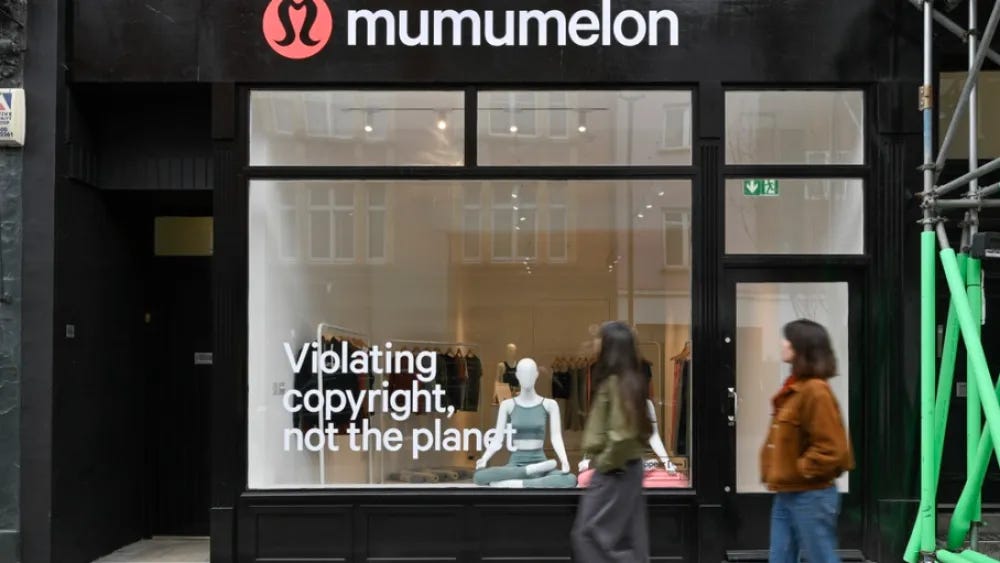
A guy walked into the store with Lululemon shopping bags in hand. After hearing the pitch, he wondered out loud whether he should return everything he'd just bought. Several tourists tried to buy the garments. The answer was no. They weren't for sale. Mumumelon isn't a real brand.

Mumumelon is a parody. A deliberate and shameless copy of Lululemon, created by Action Speaks Louder (a climate NGO that's been pressuring the fashion industry for years) and Serious People (a creative studio specializing in climate campaigns). They produced 43 garments, opened the store for two days, sold nothing, and generated more press coverage than most brands achieve in a year. Fast Company, WWD, design media, sustainability publications. Viral across all platforms.
Lululemon, which reported over $11 billion in revenue last year, responded with a statement saying they were "disappointed" with the approach. In other words: nothing.
Lululemon's own original manifesto says: "What we do to the earth, we do to ourselves." In that same year, their greenhouse gas emissions rose 14%. They've risen every year since they started measuring. They nearly doubled between 2020 and 2024, surpassing 1.69 million metric tons. 99% comes from their supply chain, where factories continue operating on coal, and to top it off, the company removed its time-specific renewable energy targets from its website and abandoned its 2025 commitment to reduce single-use plastics.
Mumumelon's question is simple: if a fake brand with zero budget can do this in weeks, why can't a company with eleven billion dollars?
The strategy behind the parody
The easy thing is to see Mumumelon as a clever joke. The interesting thing is to see the three strategic decisions that make it work. Because this isn't conventional activism. It's strategic campaign design, and every decision has a logic that any business leader should study.
1. They showed the solution, not the problem.
Traditional activism shouts "you're bad." Petitions, open letters, posters, hashtags. Mumumelon did something different: it built the improved version. They didn't publish a report on emissions. They manufactured clothing in clean factories. They didn't demand an electrification plan. They published their own.
This completely changes the conversation. It's no longer an NGO asking a corporation to change. It's someone demonstrating that change is already possible, cheap, and fast. The burden of proof is reversed. Now the question isn't "why should I change?" but "why haven't you changed?"
2. They spoke in the adversary's language.
They didn't make a protest flyer. They made a perfect store. With the same level of craft, the same obsession with detail, the same aspirational minimalism that Lululemon uses to sell premium-priced yoga pants.
This is key. If you want to change an industry, talking to it from the outside doesn't work. The NGO report stays on someone's desk in CSR. But when someone replicates your business with better integrity, that keeps you up at night. Because it's not an activist with a sign. It's a mirror.
3. They were radically honest about their own limitations.
In their FAQ section, Mumumelon admits their products aren't "sustainable." That any brand claiming to be probably is greenwashing. That they use synthetic materials in the yoga sets. And that their own supply chain has room for improvement.
That transparency gave them something no certification seal can buy: moral credibility. In an era where consumers detect bullshit almost by instinct, the brand that admits what it doesn't know and what it lacks generates more trust than the one presenting a perfect report where everything works out.
What nobody wants to discuss
Mumumelon opened for two days. Produced 43 garments. Sold nothing. And still, their own page includes a legal parody disclaimer because they know Lululemon's lawyers could destroy them in weeks. The banner running at the bottom of their site says: "Bring on the lululawyers."
The legal system protects a brand's intellectual property with speed and force. There are entire teams dedicated to that, clear precedents, fast mechanisms. If you copy a logo, they come down on you.
But that same system doesn't have equivalent mechanisms to protect the planet from that same brand's broken promises. You can double your emissions, remove your climate targets from your website, and keep operating without real consequence.
The trademark is sacred. Environmental commitment is optional. READ IT AGAIN.
Mumumelon could be legally destroyed in months. Lululemon can keep breaking its climate commitments for years.
What the consumer already decided (and you still haven't)
While companies debate internally whether sustainability is "worth it," the consumer already voted. Sustainable products grow 2.3 times faster than conventional ones. They already represent nearly 24% of market share in consumer goods. And they achieve a price premium over 26% above their traditional equivalents. 85% of consumers report experiencing the effects of climate change in their daily lives.
This isn't a progressive niche. It's the market. And 80% of a product's environmental impact is determined before manufacturing, in the design phase. Not in the report, not in the certification, in the design.
But most companies remain trapped in the compliance trap: they invest time and money in meeting regulations, producing reports and obtaining certifications, but never get to the question that really matters: how do I turn sustainability into competitive advantage, into new revenue and real differentiation?
The Big Four give you the report. Local ESG consultancies give you the carbon footprint. But nobody designs the business model for you. Nobody helps you redefine your purpose, your value proposition, or your customer experience with sustainability as a strategic lens. Nobody transforms what exists to make it worth reporting.
That's exactly the space we seek to occupy from Around. We don't come from compliance or auditing. We come from 12 years designing strategy and innovation in Mexico and Latin America. We work across three horizons according to each organization's maturity: regulatory (when you need to comply), strategic (when you want to differentiate), and transformational (when you want to lead with circular economy, ecodesign, and new business models). We do it with business strategy thinking, design agility, and human teams with judgment amplified by artificial intelligence.
The question Mumumelon leaves for your company
It goes beyond "are you doing enough for the planet?" That question is easy to dodge with a nice report.
The real question is: if someone built a version of your company that did the same thing you do, but better for the planet, how long would it take to expose you?
If the answer makes you uncomfortable, you don't need a better report.
You need a better strategy.
Related articles
- I Am Who I Am Because I Steal Music. — 25 years stumbling, failing and rediscovering myself.
- Being a Dangerous Man — If I ever have boys, they'll be dangerous men." from the poem by Daragh Fleming
- The Inertia Innovation Index that IDEO validated for us — The Inertia Innovation Index measures the ratio between the value of an opportunity when it's born and what your organization actually produces with it.