I Am Who I Am Because I Steal Music.
Category: cultura
Bernardo Torres, Founder, Uncommon Business - 2026-04-17
On April 16th, I participated in the FuckUp Nights at the Transforma International Design Congress, GDL 2026. The following text is the story I shared, my personal story raw, not as it looks on LinkedIn.
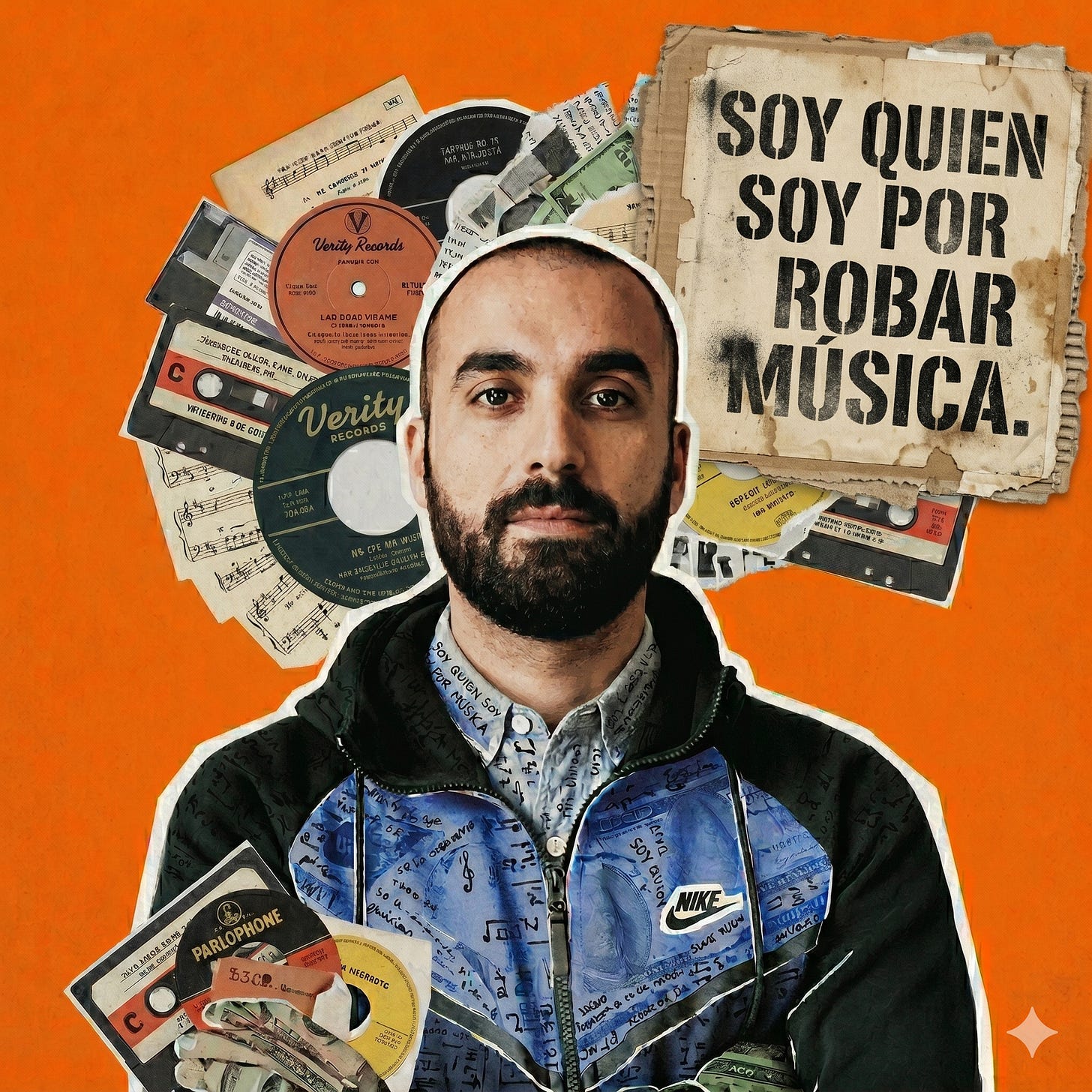
Everything I know how to do, everything that feeds me today, everything that allowed me to build a company, have clients and stand in front of hundreds of people to tell my story, started because I'm a music lover.
Not because I was an innovation or digital visionary. Not because I had a life plan with milestones and KPIs. Because I wanted to listen to albums I couldn't afford to buy.
I studied Communication and Film Directing. My plan was to make film and radio, tell stories, direct. Digital wasn't on my radar as a career. It was on my radar as a necessity, because if you wanted to listen to music in the late 90s, and you didn't have money for the album at Mixup, you had to search for it and steal it online.
Back then we were a few cats on the internet looking for rare music at 2 in the morning. With a modem that took 45 minutes to download a single MP3 song, praying that nobody in your house would pick up the phone, because if they picked it up the connection would drop and you'd start from zero.
And there I was, every night. Not because I was a nerd. Because Portishead, Radiohead and Massive Attack mattered more to me than sleep.
What I didn't know is that in that obsession I was building, unintentionally, the skillset that would define my career. HTML to participate in music forums. Photoshop to design the covers for the albums I burned. Networks, servers, P2P infrastructure. All learned alone in my house, without a teacher, without a YouTube tutorial (because YouTube didn't exist).
Digital skills that in the year 2000 were completely useless. Nobody paid you for knowing how to download music from the internet. Ten years later, those same skills would be worth gold.
First lesson from this 25-year journey: what will serve you most in life you're probably learning at 2 in the morning. Without anyone asking you to. That thing you do in your free time, that thing that you're passionate about and that doesn't seem "productive," that thing you're embarrassed to confess because it doesn't look professional, pay attention to it. Because that's probably where your real competitive advantage is.
That's the pretty part. Now comes the part where I screw up.
Phase 1: The star employee
I left university and instead of pursuing film, (I tried radio a few times and they rejected me endlessly), instead of betting on digital which I was clearly good at, I went for the safe route. I entered the corporate world, out of necessity.
I did well. That's the problem.
I grabbed a position. Moved up. Another position. Moved up again. Every year or two a new title on the business card, a salary a little bit better. And every time I felt that itch, that voice telling you "this isn't your thing, you don't belong here," I shut it up with the next achievement. "Wait for the promotion." "Wait for the bonus." "Wait for the next project."
12 years like that. Twelve.
And the thing is the corporate system works in a very simple way. It trains you like a dog. Reward and punishment. You do what they tell you, you meet the metrics, you don't question too much, and they reward you: you advance faster than others, new title, illusion of progress. You question, you propose something different, you say you don't agree, and they punish you: you stay behind, you don't grow, you become invisible.
The reward is always the same: advancing more than others. At first it feels incredible, it feels like you're winning, like you're special, like the system chose you. But they're not rewarding you for being good, they're rewarding you for being obedient, and there's a huge difference.
The most fucked up thing is that without realizing it, you copy the system. You start measuring your life in promotions, in bonuses, in titles. You start comparing yourself with your colleagues and you become addicted to winning a race you didn't even choose to run.
And nobody around you says anything, because from the outside you look successful. Your family is proud. Your salary grows. You have insurance, Christmas bonus, savings account. You're "fine."
You look successful.
That's the most dangerous trap that exists. A comfortable life that isn't yours.
I didn't leave corporate because I had an epiphany, there was no moment of illumination. I left because my body couldn't take the lie anymore. Because the next promotion didn't excite me anymore, because I looked in the mirror and didn't recognize the guy looking back at me.
Comfort is fear's favorite disguise. And I wore it for 12 years.
Phase 2: The "now I'm ready" entrepreneur
I founded Uncommon in 2014. Without a master plan. With pure fear and a hunch.
Here I should tell you I found my purpose, that money flowed, that I was finally in the right place. But no. What I discovered is that leaving corporate doesn't cure you, it just takes off the disguise.
Because outside there's no longer a boss to applaud you or a title to validate you. It's just you, asking yourself if what you do is worth anything. And the need for validation I had inside didn't disappear, it just changed shape.
Instead of seeking promotions, I sought big clients. Instead of impressing the boss, I wanted to impress the market. I changed the scenery. But I kept acting the same.
That's something they don't tell you when you start a business. Everyone talks to you about product-market fit, about raising capital, about unit economics. Nobody talks to you about how the first business you need to fix is the one you have with yourself.
You can change jobs, cities, industries. But if you haven't really looked at yourself in the mirror, you take yourself with you everywhere. Wherever you go, there you'll be waiting for yourself.
Phase 3: The impulsive investor
And then came the phase I'm most embarrassed about. The "I made it, now I'm going to multiply" phase.
When the business starts working, you get a confidence you didn't earn. You feel like hot shit, and you start making decisions with emotion instead of analysis.
I invested in a mezcal brand, because I love mezcal and it sounded good to say "I have a mezcal brand."
I invested in restaurants. Because it felt awesome to be "the owner."
I invested in a brewery. That one's going well, I'll even give that one a commercial. Cervecería Nómada. Even so I invested to say to the outside world, I have a Brewery.
I invested in an EdTech. Because I wanted to be the guy who bets on education and technology. Good intentions without a business model, very noble, very nice, and very expensive.
And a FoodTech. Someone sold me a nice story and I bought without doing the homework. If you don't understand where you're getting into, someone else understands your money better than you do.
Notice the pattern?
Every investment was a story I wanted to tell myself. It was a character I wanted to play. The mezcalero. The restaurateur. The visionary investor.
It was ego with a checkbook (that ran out).
The market doesn't forgive decisions you make with your gut instead of your head. Being impulsive isn't being risky, it's being lazy, because doing the analysis, talking to the right people, taking the time to understand before putting in the money, that does require discipline. The other thing only requires adrenaline.
Phase 4: The one who's finally shutting up to listen
25 years later. Still learning.
The most fucked up plot twist of this whole story is that everything I just told you, the corporate world, the businesses that crashed, the money I lost, the stupid decisions, all of that is what allows me today to sit in front of a CEO and tell them things their team doesn't dare tell them. Because I've already told them to myself. Late, but I told them.
Today I work in strategy, not design. In thinking, not pretty execution. And the tools I use I learned pirating music, studying film, surviving a corporation, and losing money in businesses I didn't understand.
It's not that I made it, it's that I'm not as afraid anymore to say I don't have it figured out. And above all my identity no longer depends on external validation.
It's not about stopping screwing up, we're all going to keep screwing up. It's about stopping lying to yourself about why you screwed up.
The maxims that summarize my learning
After 25 years of stumbling, I'm left with three things I wish someone had told me when I was starting.
The messy path is a superpower. The market rewards specialization with money. But the most interesting careers are built by those who connect dots that nobody else sees. Pirated music gave me digital. Film gave me narrative. Corporate taught me how power works. Lost investments taught me humility. None of that was in the plan. All of that is what makes me different. What seems like a detour today, tomorrow will be an advantage.
External success is a drug, and tolerance builds up fast. The first achievement feels incredible. The second a little less. The fifth you don't even feel anymore. If you're building your career to impress someone, your parents, your ex, LinkedIn, you're going to get where you want to get, and it won't be enough. The game changes when you stop asking "how do they see me?" and start asking "does this matter to me?"
Don't romanticize professional discipline. Design is a tool, your company is a vehicle, it's not your identity. The day I stopped saying "I'm a designer," "I'm a consultant," "I'm a founder," "I'm hot shit," and started saying "I solve problems, I move conversations, I shake the hornet's nest, I inspire," everything changed.
I don't need the right title, or the right master's degree, or the trendy certification, or the perfect plan. I got here from communication, film, Napster and a collection of failures that don't fit on a slide.
If something makes me uncomfortable today, if there's a voice telling me this isn't mine, that I should be doing something else, that something doesn't sit well with me, I don't shut up anymore. It's the most honest signal of my identity looking for another path.
A professional career isn't a straight line. It's a messy playlist, and the best songs are the ones you discover by accident at 2 in the morning.
Related articles
- Mumumelon, the New Brand That Humiliated Lululemon — What Mumumelon teaches companies that still think a PDF will save them.
- Being a Dangerous Man — If I ever have boys, they'll be dangerous men." from the poem by Daragh Fleming
- The Inertia Innovation Index that IDEO validated for us — The Inertia Innovation Index measures the ratio between the value of an opportunity when it's born and what your organization actually produces with it.